Login
Login
 Registration
  Contact
  En
En 

A high flow shower mixer becomes particularly useful when a shower system needs to supply several outlets or a water-intensive outlet without restricting the available flow. Large rain showers, waterfall outlets, body sprays, and multi-function concealed shower systems can place much greater demand on the waterway than a basic single-outlet shower.
However, choosing a high-flow mixer does not automatically guarantee stronger shower performance. The available water pressure, pipework, hot-water supply, valve design, and outlet requirements all influence the final result.
For architects, bathroom designers, installers, and project buyers, the key question is therefore not simply whether a mixer is described as "high flow." The more useful question is whether the complete shower system can deliver the flow required by the selected outlets under actual site conditions.
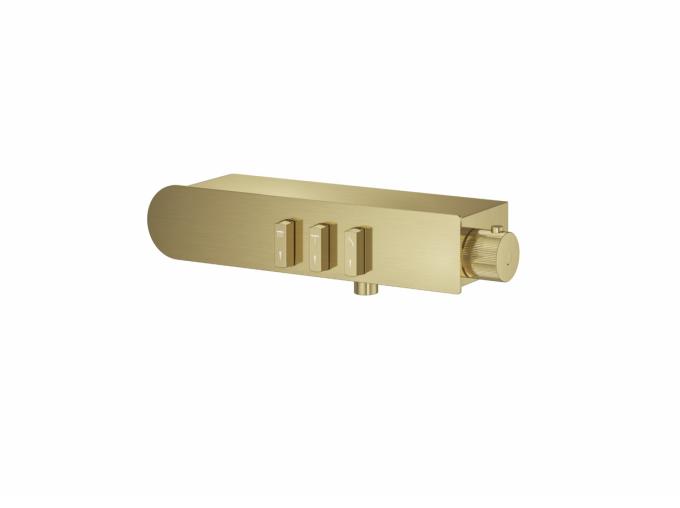
A high flow shower mixer is designed with a waterway and valve configuration capable of handling greater water demand than a conventional mixer intended for simpler shower arrangements.
Like other shower mixers, it controls the hot and cold water entering the shower. Depending on the design, it may also work with thermostatic temperature control, diverters, volume controls, or individual outlet controls. The main difference is that its internal waterway is engineered for applications where maintaining sufficient water delivery is especially important.
This becomes relevant when a system feeds more demanding shower functions. A single hand shower, for example, generally presents a different hydraulic requirement from a concealed system supplying a large overhead shower together with additional outlets.
In some FLOVA high-flow concealed valves, 3/4-inch inlets are used to support higher-capacity water delivery. Selected designs combine these larger inlets with several outlets, allowing the valve to form the control center of a more complex shower installation.
It is important to view the mixer as part of the complete water path. Water still has to travel through the building supply, pipework, valve, controls, hoses or shower arms, and finally the outlet. A high-capacity valve cannot compensate for an inadequate supply elsewhere in the system.
Multi-outlet shower systems are increasingly used in premium residential bathrooms, hotels, wellness spaces, and other projects where the shower is designed as more than a single overhead outlet.
One common example is a bathroom combining a large rain shower with a hand shower. If only one outlet operates at a time, the system may have relatively modest flow requirements. If the design allows both to operate together, the mixer and upstream supply need to accommodate their combined demand.
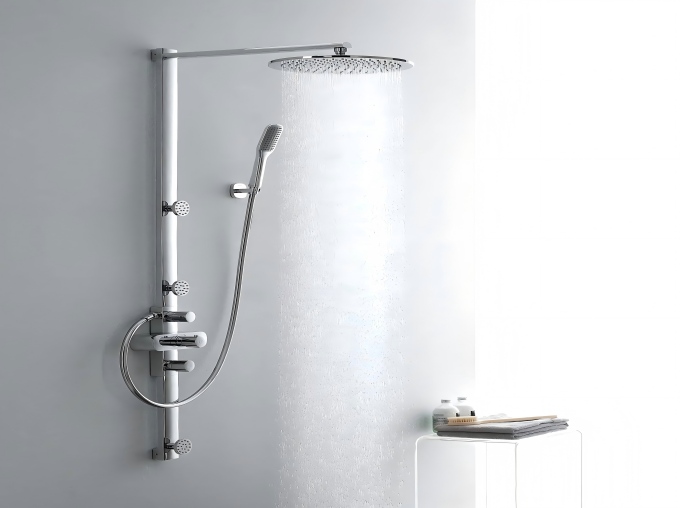
The difference becomes more significant in spa-style installations. A system may combine an overhead shower with body sprays, a waterfall function, or additional shower modes. In these applications, restricted flow at the valve can reduce the performance of individual outlets when several functions are activated.
A high flow shower mixer is therefore particularly relevant when:
multiple outlets may operate simultaneously;
the design includes a large rain or cascade outlet;
the shower incorporates several independently controlled functions;
the project calls for a generous, spa-style water experience;
the concealed installation needs to support future outlet configurations.
The number of outlets alone should not determine mixer selection. Two low-demand outlets can impose less load than one water-intensive feature. Designers should consider the actual water requirement of the selected showerheads and functions rather than simply counting connections.
This approach is especially important at the specification stage, when valve capacity can still be coordinated with pipework and the hot-water system. Correct planning before wall finishes are installed is considerably easier than trying to correct insufficient water delivery after commissioning.
The practical difference between standard and high-flow mixers is best understood through their intended applications rather than through the product name alone.
| Factor | Standard Shower Mixer | High Flow Shower Mixer |
|---|---|---|
| Typical system | Simple single-outlet or basic shower | Multi-outlet or higher-demand shower |
| Water demand | Moderate | Higher or combined demand |
| Simultaneous outlets | Usually limited | Better suited to multi-function designs |
| Common applications | Hand shower, standard overhead shower | Large rain shower, waterfall outlet, body sprays, spa-style system |
| System planning | Relatively straightforward | Requires closer coordination with supply and pipework |
A standard shower mixer can be the correct choice for many bathrooms. Installing a higher-capacity mixer where the outlets do not require additional flow provides little practical benefit.
Conversely, selecting a restrictive valve for a multi-outlet installation can create a bottleneck. Even when adequate water reaches the bathroom, the valve may limit how much can reach downstream outlets at the same time.
This is why manufacturers, designers, and contractors should evaluate the shower as a system rather than selecting each component independently.
There is also a distinction between flow capacity and temperature control. A thermostatic mixer is designed to regulate mixed-water temperature, while high-flow design addresses water delivery capacity. A shower mixer can incorporate both functions, which can be particularly useful in sophisticated concealed systems where stable control and sufficient water delivery are both required.
The shower mixer is only one factor determining how the finished system performs. Several parts of the installation need to work together.
Flow performance begins upstream of the mixer.
A building with limited incoming supply cannot produce unlimited shower flow simply by installing a larger valve. Static pressure alone also does not tell the full story. What matters during operation is whether the system can continue supplying sufficient water while the required outlets are running.
For project applications, this should be checked before the final valve and outlet combination is specified.
Pipework can become a restriction when a high-demand shower is supplied through an undersized water path.
This is one reason selected FLOVA high-flow concealed valves use 3/4-inch inlets. The larger inlet forms part of a waterway intended for higher-flow applications, although the suitability of any valve still depends on the complete installation.
The same principle applies before and after the valve. A well-designed mixer cannot deliver its full potential if another part of the system creates a significant restriction.
Different shower outlets use water differently.
A hand shower designed for controlled everyday use does not necessarily require the same supply as a large rain shower or broad cascade outlet. When several outlets operate together, their combined demand becomes especially important.
The specification should therefore begin with the desired shower experience:
Which outlets will be used, and which of them need to operate at the same time?
That answer provides a much better foundation for valve selection than choosing a high-flow product first and designing the rest of the system around it.
High-flow installations also place greater demand on the hot-water source.
If the shower mixer can pass more mixed water than the hot-water system can continuously provide, the desired experience will still not be achieved. This becomes increasingly important for prolonged multi-outlet use.
For hotels and larger residential projects, the shower specification should therefore be coordinated with the wider plumbing and hot-water design rather than treated as an isolated bathroom fixture decision.
Flow capacity also needs to match how users will control the shower.
Some systems switch between outlets, while others allow several functions to operate together. These two arrangements can have very different water demands even when they use the same number of shower outlets.
FLOVA's GoClick shower control technology, for example, includes configurations in which individual water flows can be controlled independently. Its high-flow designs are intended to support sophisticated multi-function shower arrangements where convenient control and water delivery need to work together.
FLOVA develops shower mixers and concealed shower systems for a wide range of bathroom configurations, from conventional shower arrangements to multi-function installations designed around rain, cascade, hand-shower, and other shower experiences.
Within the wider FLOVA product range, project teams can evaluate shower solutions according to the required control method, outlet configuration, finish, and installation concept.
For more demanding systems, selected FLOVA concealed valves feature forged brass bodies, 3/4-inch inlets, multiple outlet configurations, and high-flow waterways. FLOVA also combines high-flow design with technologies such as thermostatic control and GoClick, allowing designers to create multi-function systems without treating water delivery and user control as separate considerations.
The correct solution still depends on the project.
A hotel bathroom with one overhead shower has different requirements from a premium residential shower containing multiple independently controlled functions. FLOVA therefore recommends evaluating the planned outlets, operating combinations, available supply, concealed installation requirements, and desired control experience before final product selection.
For architects, distributors, bathroom designers, or project buyers working on a multi-outlet shower, contact FLOVA to discuss the required shower configuration and identify an appropriate solution for the project.
A high flow shower mixer is most valuable when the shower design creates genuine demand for greater water delivery, particularly in multi-outlet, large rain shower, cascade, or spa-style systems.
The mixer, however, should never be evaluated in isolation. Incoming water supply, pipe size, hot-water capacity, valve waterways, outlet demand, and the way different shower functions operate together all affect real-world performance.
For project specification, the best approach is to define the desired shower functions first and then select a valve system capable of supporting them. This helps avoid both underspecifying a complex shower and unnecessarily using a high-capacity solution where a conventional mixer would perform equally well.
No. A high-flow mixer can reduce restrictions within an appropriately designed system, but it cannot create water pressure or supply that is not available upstream.
No. The decision depends on the flow demand of the outlets and whether several functions will operate simultaneously. Some multi-outlet systems simply divert water between functions.
No. "Thermostatic" refers primarily to temperature regulation, while "high flow" describes water-delivery capacity. A mixer can incorporate both characteristics.
Larger inlet connections can support a less restrictive water path for higher-demand systems. They still need to be matched with suitable upstream pipework, water supply, and downstream outlets.


+86-576-87332270